
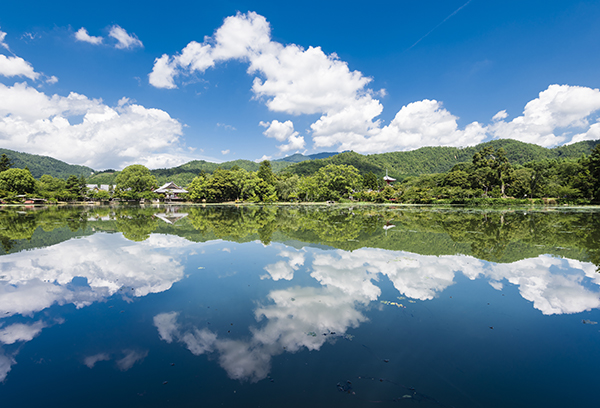
The garden is located at the east of Daikaku-ji. Its perimeter is approximately 1km and the garden is Japan’s oldest example of an artificial grove and ponds. It is also called “Teiko (庭湖)” since Emperor Saga created the garden after the Tang Dynasty’s Dongting Lake (洞庭湖), during the construction of his villa, Saga-in.
cultural property : historic sites and places of scenic beauty as natural monuments
type : places of scenic beauty
4 Sagaōsawachō, Ukyō-ku, Kyōto-shi, Kyōto-fu 616-8411
Tel:075-871-0071(Daikakuji Offical)
Tel:075-871-0191(Property Administration Section)
Home page : https://www.daikakuji.or.jp/precincts/
In the early Heian Period, a pond and a waterfall were added to the garden of the villa Saga-in built during the Konin Era (810-824), and the rule of Emperor Saga. The garden is also called Teiko (庭湖) since it was modeled on Dongting Lake (洞庭湖) in China.
The pond has Tenjin (heavenly God) Island, Kiku-ga-shima (chrysanthemum island), and a Teiko stone. A waterfall is located at the north section of the pond. Based on the excavation survey, it is assumed that when the garden was built, the pond had a large amount of water. However, in a poem, Fujiwara-no-kinto (966-1041) reads: “Although the sound of the waterfall has been gone for a long time, its fame is still flowing and I can hear the reputation.” This suggests that the pond was already dry by the mid-Heian Period.
At the pond shore, there is a Gosha Myojin (a shrine of five deitities), of which the deities are said to have been divided and transferred to the villa as Chinju (Tutelary Deities of Land) by Kobo Daishi. The garden is well-known for blossoms, as many cherry trees are planted there. It is also famous for moon-viewing. Many people visit the garden for cherry blossoms in spring and to enjoy the moon in fall.